Unimolecular vs Bimolecular Reactions: Essential Differences Explained
Understanding Reaction Mechanisms in Chemical Kinetics
Chemical kinetics is the study of reaction rates and the factors that influence them. At its core, this field examines how quickly reactants transform into products and the molecular pathways involved. The classification of reactions based on molecularity—the number of molecules participating in the rate-determining step—provides essential insights into reaction mechanisms.
When we examine reactions at the molecular level, we observe fascinating behaviors that depend on energy distribution, molecular orientation, and collision dynamics. Have you ever wondered why some reactions happen almost instantaneously while others require catalysts or extreme conditions? The answer often lies in understanding whether a reaction follows a unimolecular or bimolecular pathway.
In laboratory settings, determining reaction order and molecularity helps chemists predict outcomes and optimize conditions. These fundamental concepts extend beyond academic interest—they inform industrial processes, pharmaceutical development, and environmental chemistry. I've always found it remarkable how these microscopic interactions ultimately drive macroscopic phenomena we observe in everyday life.
What Are Unimolecular Reactions?
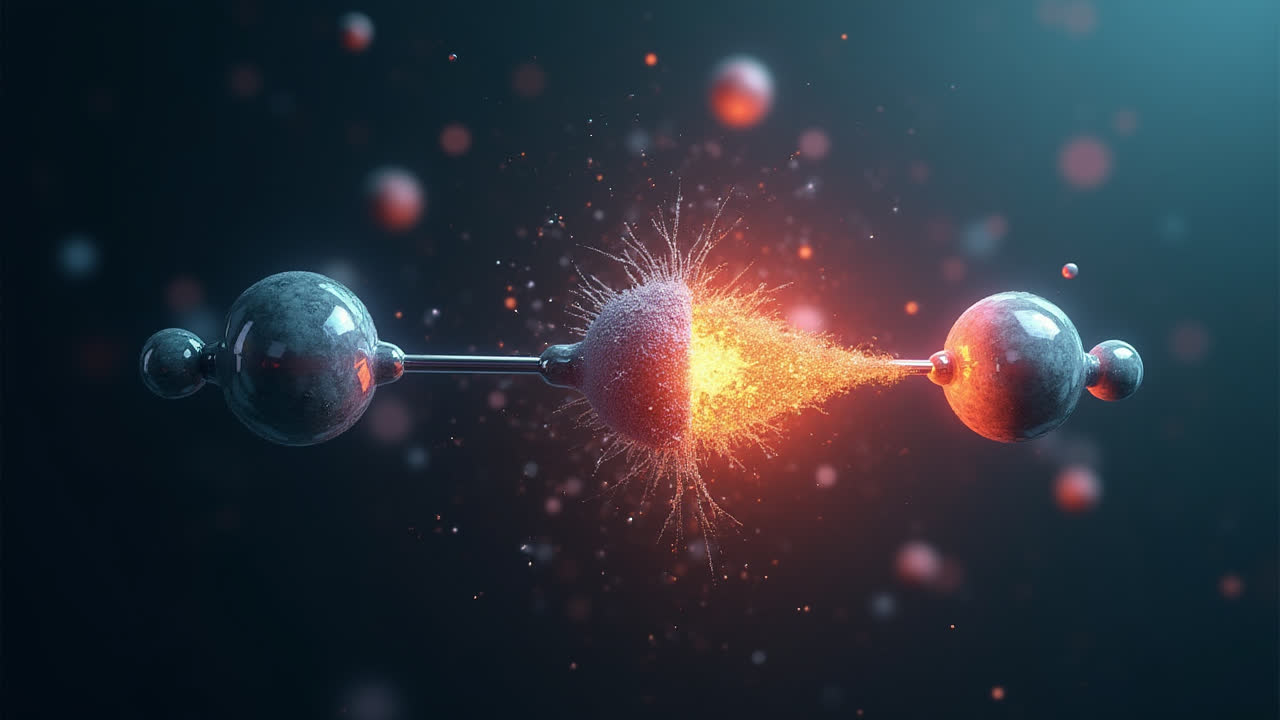
A unimolecular reaction involves the transformation of a single molecule. These reactions typically follow first-order kinetics, where the rate depends solely on the concentration of one reactant. The most common types include dissociation (breaking apart) and isomerization (rearrangement of atoms within the same molecule).
For a unimolecular reaction to occur, the molecule must first gain sufficient energy to overcome the activation barrier. This energy usually comes from collisions with other molecules or absorption of radiation. Once activated, the molecule can undergo internal changes without requiring further interaction with additional molecules. The fascinating aspect of these reactions is that they represent a kind of molecular "decision-making" process—the molecule reaches a critical energy state and then transforms independently.
In gaseous systems, unimolecular reactions often follow the Lindemann-Hinshelwood mechanism. This model explains how a molecule becomes activated through collisions before undergoing the actual transformation. The rate-determining step involves only the activated molecule, making it truly unimolecular despite the initial activation requiring collisions.
Some common examples of unimolecular reactions include:
- Radioactive decay processes
- Decomposition of azomethane (CH₃N₂CH₃) into nitrogen and ethane
- Thermal decomposition of cyclobutane to ethylene
- Cis-trans isomerization of certain alkenes
- E1 elimination reactions in organic chemistry
What Are Bimolecular Reactions?
Unlike their unimolecular counterparts, bimolecular reactions involve the collision and interaction of two distinct molecular species. These reactions typically follow second-order kinetics, where the rate depends on the concentrations of both reactants. The effectiveness of these reactions depends on successful collisions—molecules must meet with proper orientation and sufficient energy.
Bimolecular reactions form the foundation for numerous chemical transformations in organic, inorganic, and biochemical systems. The collision theory helps explain their behavior: as concentration increases, so does the frequency of molecular collisions, thereby increasing reaction rates. Temperature also plays a crucial role, as higher temperatures increase the proportion of collisions with sufficient energy to overcome the activation barrier.
One particularly interesting type of bimolecular reaction is the SN2 (bimolecular nucleophilic substitution) mechanism in organic chemistry. This elegant process involves a nucleophile attacking a substrate while simultaneously displacing a leaving group. The reaction proceeds through a transition state where both the incoming and outgoing groups are partially bonded to the central atom, resulting in an inversion of stereochemistry—like an umbrella flipping inside out during a storm.
Common examples of bimolecular reactions include:
- The reaction between hydrogen and iodine to form hydrogen iodide
- SN2 reactions in organic chemistry
- E2 elimination reactions
- Many neutralization reactions between acids and bases
- Numerous enzyme-substrate interactions in biochemistry
Key Differences: Unimolecular vs Bimolecular Reactions
While both reaction types are fundamental to chemical kinetics, they differ significantly in their mechanisms, requirements, and behaviors. Understanding these differences helps chemists predict reaction outcomes and design effective synthetic pathways.
| Characteristic | Unimolecular Reactions | Bimolecular Reactions |
|---|---|---|
| Number of Molecules | Involves a single molecule | Involves two distinct molecules |
| Reaction Order | Typically first-order kinetics | Typically second-order kinetics |
| Rate Equation | Rate = k[A] | Rate = k[A][B] |
| Mechanism | Intramolecular rearrangement or bond breaking | Intermolecular collision and interaction |
| Energy Requirement | Energy must accumulate in a single molecule | Collision energy must exceed activation energy |
| Concentration Effect | Rate linearly proportional to concentration | Rate proportional to product of concentrations |
| Example Reactions | Isomerization, decomposition, E1 elimination | SN2 reactions, E2 elimination, neutralization |
| Temperature Dependence | Increases rate by increasing fraction of molecules with sufficient energy | Increases rate by increasing collision frequency and energy |
Similarities Between Unimolecular and Bimolecular Reactions
Despite their differences, unimolecular and bimolecular reactions share important commonalities that highlight fundamental principles in chemical kinetics.
Both reaction types follow the Arrhenius equation, which relates reaction rate constants to temperature and activation energy. This mathematical relationship helps chemists predict how reaction rates will change under different conditions. I've often found this equation to be one of the most elegant expressions in chemistry, connecting the microscopic world of molecular energy with macroscopic reaction rates we can measure in the lab.
Another similarity is the formation of transition states—high-energy, unstable arrangements that exist momentarily during the reaction. These transition states represent the "mountain peak" that must be crossed during the reaction's energy pathway. In both reaction types, the energy required to reach this transition state (activation energy) determines the reaction's feasibility and rate.
Additionally, both reaction types involve changes in energy levels, bonding patterns, and molecular structures. Whether a molecule transforms on its own or through collision with another, the fundamental principles of bond breaking and forming remain consistent with the laws of thermodynamics and quantum mechanics.
Applications and Significance in Chemistry
The distinction between unimolecular and bimolecular reactions extends far beyond theoretical interest—it has profound implications across various scientific disciplines and practical applications.
In atmospheric chemistry, understanding these reaction mechanisms helps scientists model the complex transformations of pollutants and greenhouse gases. For instance, the decomposition of ozone in the stratosphere involves both unimolecular photodissociation and bimolecular reactions with other atmospheric components. These processes influence our climate and environmental quality in ways we're still working to fully understand.
Pharmaceutical development relies heavily on reaction mechanism knowledge to design efficient synthetic routes for drug molecules. By selecting conditions that favor either unimolecular or bimolecular pathways, chemists can control stereochemistry, minimize side reactions, and optimize yields. This knowledge translates directly into more affordable and accessible medications.
In biochemistry, enzyme-catalyzed reactions often follow complex mechanisms that incorporate aspects of both uni- and bimolecular steps. The exquisite specificity of these biological catalysts stems from their ability to position reactants perfectly for either intramolecular rearrangements or intermolecular interactions. Nature has evolved these systems over millions of years, and we're still learning from their elegant solutions.
Industrial processes, from petroleum refining to polymer production, leverage understanding of reaction mechanisms to develop catalysts and optimize conditions. The economic impact of this knowledge is immense—even small improvements in reaction efficiency can translate to millions in savings and reduced environmental footprint. I've visited chemical plants where precise control of reaction pathways makes the difference between profitable operation and shutdown.
Frequently Asked Questions About Unimolecular and Bimolecular Reactions
How do you determine if a reaction is unimolecular or bimolecular?
To determine if a reaction is unimolecular or bimolecular, examine the rate-determining step of the reaction mechanism. If only one molecule is involved in this step (undergoing internal rearrangement or bond breaking), the reaction is unimolecular. If two molecules must collide and interact in the rate-determining step, the reaction is bimolecular. Experimentally, you can also analyze the reaction's kinetics—unimolecular reactions typically follow first-order kinetics (rate = k[A]), while bimolecular reactions follow second-order kinetics (rate = k[A][B] or rate = k[A]²).
What are the reaction mechanisms for E1 and E2 elimination reactions?
E1 (elimination unimolecular) follows a two-step mechanism. First, the leaving group departs, forming a carbocation intermediate. Then, a base removes a proton from an adjacent carbon, forming a double bond. This rate-determining step involves only the carbocation, making it unimolecular. E2 (elimination bimolecular) occurs in a single concerted step where the base removes a proton while the leaving group simultaneously departs. This requires the collision and proper orientation of two molecules—the substrate and the base—making it bimolecular. E2 reactions typically occur under strongly basic conditions, while E1 reactions are favored in weakly basic or neutral environments with good leaving groups.
How do temperature and concentration affect unimolecular versus bimolecular reactions differently?
Temperature affects both reaction types by increasing the proportion of molecules with sufficient energy to overcome the activation barrier, following the Arrhenius equation. However, bimolecular reactions get an additional boost because higher temperatures also increase collision frequency. For concentration effects, the difference is more pronounced: doubling the concentration of reactants in a unimolecular reaction doubles the reaction rate, but in a bimolecular reaction involving two different molecules, doubling both reactant concentrations quadruples the reaction rate. This makes bimolecular reactions more sensitive to concentration changes, which can be leveraged in industrial processes to control reaction rates. These differences in temperature and concentration dependencies provide valuable tools for distinguishing between reaction mechanisms experimentally.
Conclusion: The Significance of Understanding Reaction Molecularity
The distinction between unimolecular and bimolecular reactions represents a fundamental concept in chemical kinetics that helps scientists understand, predict, and control chemical transformations. While unimolecular reactions involve the transformation of a single molecule through internal rearrangements or bond breaking, bimolecular reactions require the collision and interaction of two distinct molecular species.
These differences extend beyond theoretical significance—they influence everything from reaction rates and product distributions to the conditions required for successful transformations. By understanding whether a reaction follows a uni- or bimolecular pathway, chemists can design more efficient synthetic routes, develop better catalysts, and model complex systems from atmospheric chemistry to biochemical processes.
As our analytical techniques continue to advance, we gain increasingly detailed insights into the molecular choreography of chemical reactions. This knowledge not only satisfies our intellectual curiosity about nature's workings but also empowers us to develop new materials, medicines, and technologies that benefit society.
The next time you observe a chemical reaction—whether it's the rusting of iron, the burning of a candle, or the digestion of food—remember that at the molecular level, these transformations follow elegant pathways involving either unimolecular or bimolecular steps. This microscopic dance of molecules, invisible to the naked eye, shapes our macroscopic world in countless ways.