Fusion vs Diffusion: Understanding the Key Differences and Applications
What is Fusion: The Powerhouse of Stars
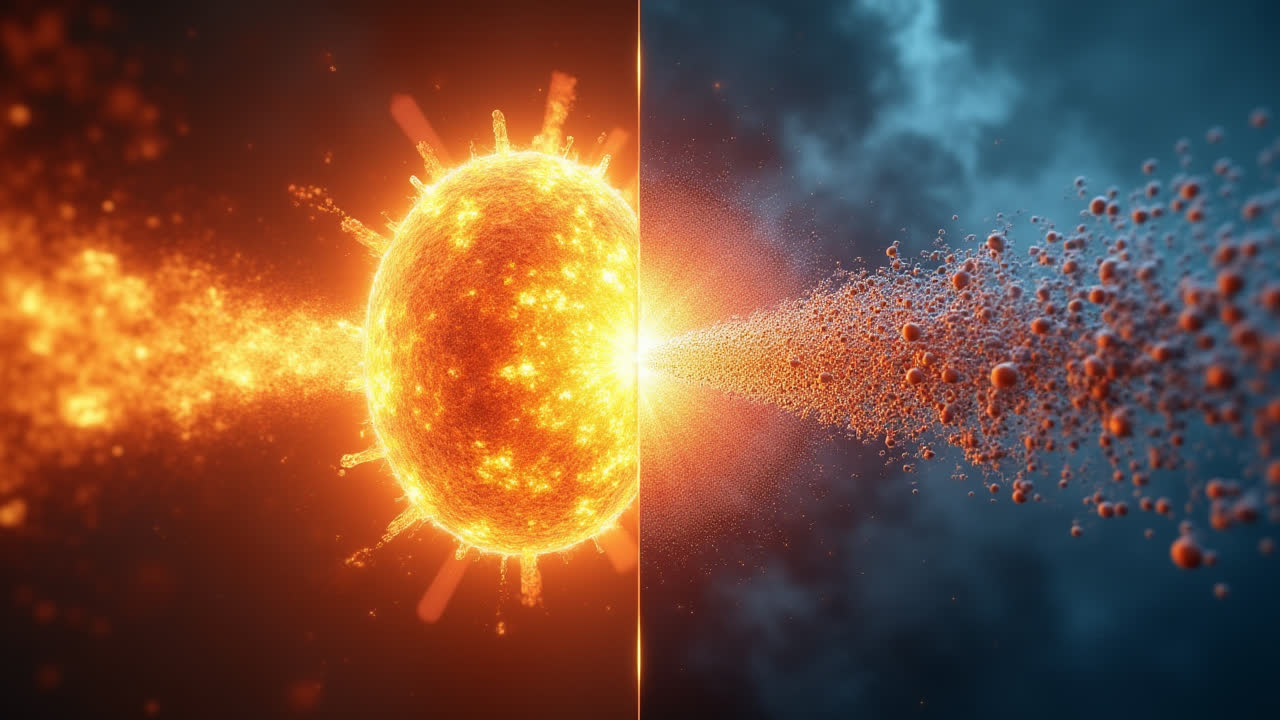
Fusion is the remarkable nuclear process where two or more atomic nuclei combine to form a single, heavier nucleus. Unlike its counterpart nuclear fission (which powers our current nuclear plants), fusion releases enormous amounts of energy without producing significant radioactive waste. This is the same process that powers our sun and all stars in the universe.
At its core, fusion requires extreme conditions. Atomic nuclei naturally repel each other due to their positive charges. To overcome this electrostatic repulsion and fuse together, these particles need incredibly high temperatures (millions of degrees Celsius) and intense pressure. When these conditions are met, the nuclei can merge, releasing tremendous energy in the process.
The most common fusion reaction being studied for energy production involves isotopes of hydrogen: deuterium and tritium. When these isotopes fuse, they create helium along with a neutron and release energy that can be expressed through the equation:
D + T → He + n + Energy
This single reaction produces several times more energy than what we could get from burning an equivalent amount of fossil fuels. What's remarkable is that fusion fuel sources are abundant – deuterium can be extracted from ordinary water, and lithium (used to breed tritium) is widely available in the Earth's crust. I've always been fascinated by how something so powerful could come from elements so common in our everyday environment.
Advantages of Fusion Energy
Why are scientists worldwide racing to develop viable fusion energy? The potential benefits are transformative. Unlike many conventional energy sources, fusion offers a unique combination of advantages that could revolutionize how we power our world.
- Nearly limitless fuel supply: Deuterium can be extracted from seawater, and lithium is abundant in the Earth's crust, providing enough fuel to last humanity for millions of years.
- Minimal radioactive waste: Unlike nuclear fission, fusion produces very little long-lived radioactive waste, making disposal and containment significantly easier and safer.
- Inherent safety: Fusion reactions require precise, difficult-to-maintain conditions. Any disruption causes the reaction to stop naturally – there's no risk of meltdowns or runaway reactions as seen in fission plants.
- Zero carbon emissions: As a clean energy source, fusion produces no greenhouse gases, offering a powerful tool in the fight against climate change.
- Energy stability: Fusion could provide reliable baseload power without the geopolitical challenges associated with fossil fuels.
Despite these promising advantages, commercial fusion power remains elusive. Scientists have been working for decades to create a fusion reactor that produces more energy than it consumes. Recent breakthroughs at facilities like the National Ignition Facility and ITER (International Thermonuclear Experimental Reactor) are bringing us closer to this goal, but we're still years away from fusion power plants feeding our electrical grid.
What is Diffusion: Nature's Spreading Mechanism
While fusion involves combining particles, diffusion represents an entirely different natural process. Diffusion is the movement of particles from areas of higher concentration to areas of lower concentration. This spontaneous process occurs as particles naturally spread out to achieve equilibrium – a state where concentration becomes uniform throughout a system.
The driving force behind diffusion is the concentration gradient – the difference in particle density between two regions. Unlike fusion, which requires extreme conditions, diffusion happens around us constantly at normal temperatures and pressures. You've witnessed diffusion if you've ever added a drop of food coloring to water or smelled perfume from across a room.
What's interesting about diffusion is that it occurs in all states of matter – gases, liquids, and even solids, though at different rates. Gases diffuse most rapidly because their molecules move freely with significant space between them. Liquids diffuse more slowly as molecules are closer together with less freedom of movement. Solid diffusion happens too, but at an extremely slow pace due to the fixed positions of molecules.
The rate of diffusion depends on several factors: temperature (higher temperatures increase diffusion rate), particle size (smaller particles diffuse faster), medium viscosity (less viscous mediums allow faster diffusion), and the steepness of the concentration gradient. These principles explain why a tea bag infuses hot water faster than cold water, and why spreading a drop of food coloring works differently in water versus honey.
Applications of Diffusion in Our World
Diffusion isn't just a scientific concept – it's a process that impacts countless aspects of our lives and industries. From biological functions that keep us alive to industrial applications that create modern products, diffusion plays a crucial role.
In our bodies, diffusion enables the exchange of oxygen and carbon dioxide in our lungs. When we inhale, oxygen diffuses from the air-filled alveoli into our bloodstream because of its higher concentration in the lungs. Similarly, carbon dioxide moves from our blood (where it's in higher concentration) into the lungs to be exhaled. Without this simple diffusion process, cellular respiration would be impossible.
In chemistry, diffusion facilitates reactions by bringing different molecules together. I still remember my first chemistry experiment watching how molecules spread through a solution without any mechanical mixing – pure diffusion at work! This natural mixing process is essential for everything from simple chemical reactions to complex industrial processes.
Environmental scientists study diffusion to understand how pollutants spread through air, water, and soil. This knowledge helps create models for predicting pollution dispersal and developing effective containment strategies. Similarly, in agriculture, understanding how nutrients diffuse through soil helps optimize fertilizer application and irrigation practices.
Modern technology also leverages diffusion in numerous applications. Semiconductor manufacturing relies on the controlled diffusion of dopants into silicon wafers. Water purification systems use processes like reverse osmosis, which work on principles related to diffusion. Even simple household items like air fresheners function through the diffusion of scent molecules through the air.
Comparing Fusion and Diffusion: Key Differences
Though both fusion and diffusion involve particle movement, they represent fundamentally different processes with distinct characteristics, requirements, and outcomes. Let's examine these differences through a detailed comparison:
| Characteristic | Fusion | Diffusion |
|---|---|---|
| Basic Definition | A nuclear process where two or more atomic nuclei combine to form a heavier nucleus | A transport process where particles move from areas of higher concentration to areas of lower concentration |
| Energy Relationship | Releases enormous amounts of energy (exothermic) | Does not typically involve energy release or absorption |
| Required Conditions | Extremely high temperatures (millions of degrees) and high pressure | Occurs at normal temperatures and pressures; rate increases with temperature |
| Scale of Process | Occurs at the nuclear level (involving atomic nuclei) | Occurs at the molecular or particulate level |
| Direction of Movement | Particles move toward each other | Particles move from higher to lower concentration |
| End Result | Creation of a new, heavier element | Even distribution of particles throughout available space |
| Natural Occurrence | Stars (like our sun), rarely on Earth outside of laboratories | Constantly occurring all around us in everyday phenomena |
| Human Applications | Potential future energy source, hydrogen bombs, nuclear physics research | Biological processes, chemical reactions, environmental modeling, industrial processes |
The fundamental difference between these processes highlights how diverse the behavior of matter can be. While fusion represents the enormous power of atomic forces coming together, diffusion demonstrates the natural tendency toward equilibrium and disorder. One builds complex atoms from simpler ones, while the other distributes particles evenly throughout their environment.
Similarities: Finding Common Ground
Despite their many differences, fusion and diffusion do share some conceptual similarities. Both processes involve the movement of particles and can be described by scientific models that predict their behavior. Additionally, both follow fundamental physical laws and represent natural processes that occur without human intervention (though fusion on Earth typically requires sophisticated technology).
Both processes are also essential to our understanding of how the universe functions. Fusion explains stellar formation and evolution, while diffusion helps explain countless natural phenomena from the spread of genetic traits in populations to the mixing of gases in our atmosphere.
Frequently Asked Questions
Is fusion a type of diffusion?
No, fusion is not a type of diffusion. These are entirely different physical processes. Fusion is a nuclear process where atomic nuclei combine to form a heavier nucleus, releasing enormous energy. Diffusion is a transport phenomenon where particles move from areas of higher concentration to areas of lower concentration. While both involve particle movement, they operate on different scales, under different conditions, and produce different results.
What are some everyday examples of diffusion?
Diffusion is observable in many everyday situations. When a tea bag is placed in hot water, the color spreads throughout the water as tea compounds diffuse from high concentration (in the bag) to low concentration (in the water). Similarly, when you spray perfume in one corner of a room, the scent molecules gradually spread throughout the space. Other examples include the absorption of nutrients through cell membranes in our bodies, the spreading of smoke in air, and the dissolution of sugar in coffee without stirring.
What is the main difference between effusion and diffusion?
Though they sound similar, effusion and diffusion are distinct processes. Effusion is the rapid escape of gas particles through a small opening or porous membrane into a vacuum or region of lower pressure. Diffusion is the gradual mixing of substances due to random particle motion from areas of higher concentration to areas of lower concentration. Effusion is typically faster and more directional (through a specific opening), while diffusion is slower and occurs in all directions. A common example of effusion is gas escaping through a tiny hole in a balloon, while diffusion would be that same gas gradually mixing with the surrounding air.
Conclusion: Different Processes, Equal Importance
Fusion and diffusion represent two fascinating and fundamentally different natural processes. While fusion combines atomic nuclei under extreme conditions to create heavier elements and release energy, diffusion disperses particles from areas of higher concentration to areas of lower concentration under ordinary conditions.
Understanding these processes isn't just academic – it has profound implications for our future. Fusion holds the promise of clean, abundant energy that could transform our relationship with power production and help address climate change. Diffusion explains countless natural phenomena and enables technologies ranging from medical treatments to industrial manufacturing processes.
As we continue to explore and harness these natural processes, we gain not only practical applications but also deeper insights into the fundamental workings of our universe. Whether combining atoms to power cities or observing molecules spreading through a solution, these processes reveal the elegant physical laws that govern our world.