Continent vs Country: 8 Critical Differences You Need to Know
Have you ever wondered about the fundamental differences between continents and countries? While we use these geographical terms daily, many people confuse their definitions and characteristics. Understanding these distinctions isn't just academic knowledge—it helps us make sense of global politics, geography, and cultural identity.
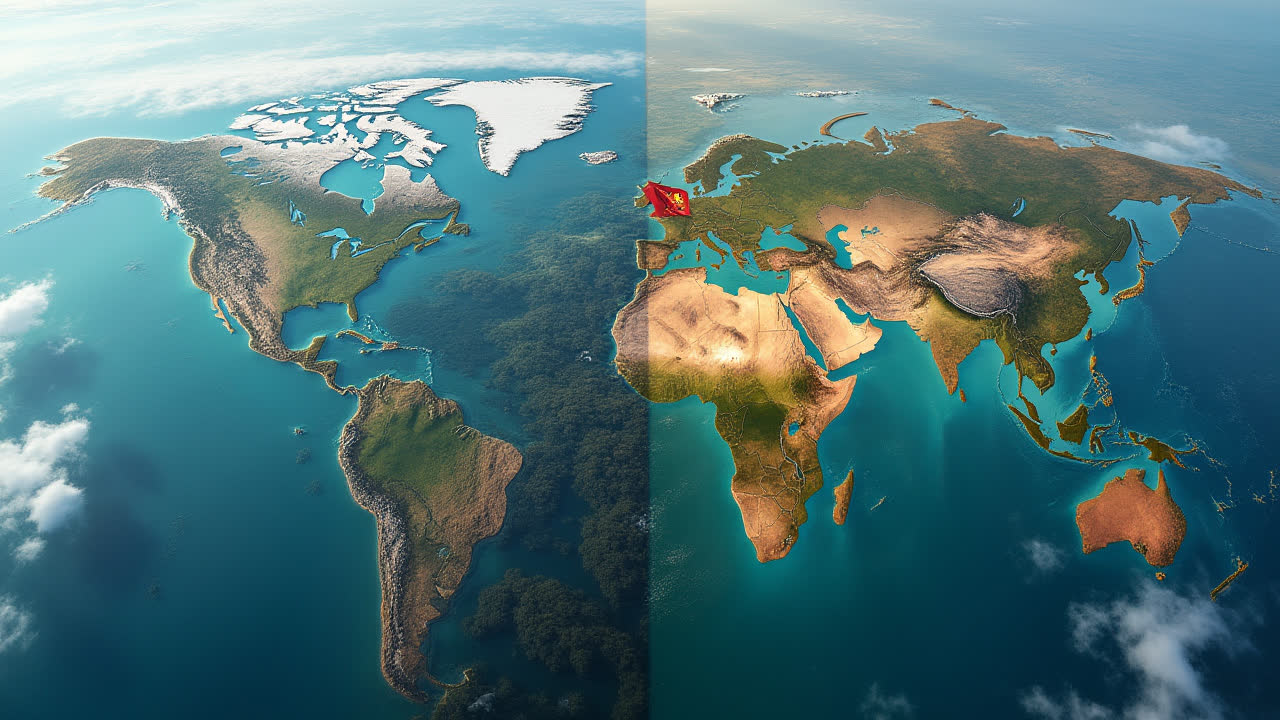
A continent and a country represent two different levels of geographical and political organization on our planet. When we look at a world map, we see both large landmasses and smaller political entities with clear borders. These visual distinctions reflect deeper differences in how these territories are defined, governed, and recognized internationally.
In this comprehensive guide, we'll explore the key differences between these essential geographical concepts and help you understand why they matter in today's interconnected world. Whether you're a student, traveler, or simply curious about our planet's organization, this knowledge will enrich your understanding of global geography.
What Is a Continent? Definition and Characteristics
A continent is a massive, continuous landmass that stands as one of Earth's principal land divisions. Geographers define continents as large landmasses separated from others by oceans or significant geological features. Our planet has seven recognized continents: Asia, Africa, North America, South America, Antarctica, Europe, and Australia.
Each continent has unique physical characteristics, including distinct tectonic plates, geological features, and natural boundaries. For example, the Ural Mountains separate Europe from Asia, while the Panama Canal marks the division between North and South America. These natural boundaries have evolved over millions of years through geological processes like continental drift.
The size of continents varies dramatically. Asia, the largest continent, covers approximately 44.6 million square kilometers, while Australia, the smallest, spans just 8.6 million square kilometers. Despite these variations, all continents share the characteristic of being major landmasses that contain multiple countries within their boundaries.
When geographers identify continental boundaries, they consider not just the mainland but also associated islands. For instance, Japan, though separated by water, belongs to the Asian continent. Similarly, islands in the Caribbean Sea are geographically part of North America. These continental shelves—gently sloping underwater plains extending from shorelines—often indicate the true continental boundaries beneath the ocean's surface.
What Is a Country? Definition and Characteristics
A country is a politically defined territory with its own government, laws, and international recognition. Unlike continents, which are primarily geographical entities, countries are political constructs created through human agreements, historical developments, and international relations. They exist within continents and represent sovereign states with control over their territories.
Currently, the world recognizes 195 sovereign countries, each with varying degrees of political autonomy and international recognition. These nations range dramatically in size, population, and political systems. Russia, the largest country by landmass, covers 17.1 million square kilometers across two continents, while Vatican City, the smallest, occupies less than half a square kilometer within Italy.
What truly defines a country is not just its physical territory but its sovereignty—the recognized authority to govern itself without external interference. This sovereignty includes the right to create and enforce laws, collect taxes, maintain armed forces, and conduct foreign relations. Most countries have constitutions or similar documents that outline their governmental structure and citizens' rights.
Many countries further divide their territories into smaller administrative units like states, provinces, or departments. These divisions facilitate governance by allowing local authorities to address regional concerns while still operating under the national government's broader framework. The United States, for example, comprises 50 states, each with its own local government working alongside the federal system.
Key Differences Between Continents and Countries
| Comparison Point | Continents | Countries |
|---|---|---|
| Definition | Large landmasses separated by oceans | Political territories with sovereign governments |
| Number | 7 (Asia, Africa, North America, South America, Antarctica, Europe, Australia) | 195 internationally recognized sovereign states |
| Boundary Determination | Natural features (oceans, seas, mountains) and tectonic plates | Political agreements, treaties, historical events |
| Governance | No single governing body (except Australia and Antarctica) | Single government with sovereignty |
| Formation | Natural geological processes over millions of years | Human decisions through political processes, wars, independence movements |
| Stability | Extremely stable, changing only over geological time | Can change through political events (mergers, splits, border disputes) |
| International Recognition | Universally accepted geographical divisions | Requires recognition from other countries and organizations |
| Internal Divisions | Divided into multiple countries | May be divided into states, provinces, or departments |
The Continental Country: Australia as a Special Case
Among the seven continents, Australia presents a fascinating exception as the only continent that is also a single country. This unique status gives Australia the distinction of being a "continental country." However, it's worth noting that the continent of Australia technically includes neighboring islands and territories like Papua New Guinea and parts of Indonesia, while the country of Australia refers specifically to the sovereign nation.
This exception highlights how geographical and political boundaries don't always align perfectly. Australia's isolation as an island continent contributed to its development as a unified nation, unlike other continents that developed multiple countries due to historical, cultural, and geographical factors. The unique case of Australia demonstrates how continental definitions can sometimes blur with political realities.
Antarctica represents another special case—a continent without countries in the traditional sense. Instead, it operates under the Antarctic Treaty System, with various nations maintaining research stations without claiming permanent sovereignty. This arrangement shows how continents can exist without being divided into conventional countries, further illustrating the fundamental differences between these geographical and political concepts.
Historical Evolution of Countries and Continents
While continents formed through natural geological processes over hundreds of millions of years, countries emerged much more recently through human social and political development. The concept of the nation-state—a sovereign political entity linked to a specific territory and population—only became widespread in the 17th century with the Peace of Westphalia in 1648, which established the principle of territorial sovereignty.
Throughout history, countries have appeared, disappeared, merged, and split based on wars, revolutions, independence movements, and diplomatic agreements. For example, the number of countries in Africa increased dramatically during the 20th century as colonial territories gained independence. Similarly, the dissolution of the Soviet Union in 1991 created 15 new independent countries in Eastern Europe and Central Asia.
By contrast, continental boundaries have remained largely stable since humans began categorizing them, with changes occurring only through our evolving understanding of geography rather than through the landmasses themselves shifting (though they do shift extremely slowly through plate tectonics). For instance, the recognition of Europe and Asia as separate continents reflects historical and cultural distinctions more than strict geographical separation.
This historical perspective underscores perhaps the most fundamental difference between continents and countries: continents are natural features discovered by humans, while countries are human constructs created through social and political processes. One exists independently of human activity; the other exists because of it.
Frequently Asked Questions
Can a country exist on multiple continents?
Yes, some countries span multiple continents. Russia is the most prominent example, with territory in both Europe and Asia, making it a transcontinental country. Similarly, Turkey straddles Europe and Asia, with Istanbul being the only major city in the world located on two continents. Egypt is primarily in Africa, but its Sinai Peninsula extends into Asia. These countries demonstrate that political boundaries don't always align with continental divisions.
Why is Greenland not considered a continent despite its large size?
Despite being the world's largest island, Greenland doesn't qualify as a continent because it doesn't sit on its own tectonic plate. Continents are defined partly by their placement on distinct tectonic plates, and Greenland shares the North American plate. Additionally, Greenland's land area (2.16 million square kilometers) is significantly smaller than Australia's (8.6 million square kilometers), which is considered the smallest continent. Geographically, Greenland is part of North America.
How do disputed territories fit into the continent-country classification?
Disputed territories are regions where sovereignty is claimed by multiple countries or entities. While these territories always belong to a specific continent based on geographical location, their political status as part of a particular country may be unresolved. Examples include Kashmir (disputed between India, Pakistan, and China) and Western Sahara (claimed by Morocco and the Sahrawi Arab Democratic Republic). These disputes highlight the distinction between geographical facts (continent membership) and political recognition (country status).
Conclusion: Understanding Our World's Organization
The distinction between continents and countries represents two fundamental ways of understanding Earth's organization—one based on natural geography and the other on human political arrangements. While continents provide the broader geographical context, countries reflect how humans have organized themselves politically within these natural boundaries.
This relationship between continents and countries helps explain many aspects of global affairs, from international relations to cultural identities. When we understand that countries are essentially political subdivisions of continents, we gain insight into both the natural and human-created structures that shape our world.
As our world becomes increasingly interconnected, these distinctions remain important for making sense of global events and relationships. Whether you're studying geography, planning international travel, or simply trying to understand world news better, recognizing the fundamental differences between continents and countries provides an essential framework for global understanding.