Understanding Associative vs Non-associative Learning: Key Differences Explained
Have you ever wondered how we learn different skills and behaviors throughout our lives? The human brain has remarkable capabilities when it comes to processing information and forming memories. Learning processes can be broadly categorized into two fundamental types: associative and non-associative learning. These learning mechanisms operate differently but play crucial roles in how we adapt to our environment and develop new behaviors.
In this comprehensive guide, we'll explore the fascinating differences between associative and non-associative learning, examine their characteristics, provide real-world examples, and understand their applications in education and psychology. Whether you're a student, educator, or simply curious about how learning works, this article will give you valuable insights into these essential cognitive processes.
What is Associative Learning?
Associative learning occurs when our brains make connections between two previously unrelated elements through conditioning. This process is fundamental to how we learn from experiences and adapt our behaviors accordingly. When I was teaching psychology to undergraduate students, I often used everyday examples to illustrate this concept - like how quickly they associated certain professors with difficult exams!
What makes associative learning so powerful is that it involves forming connections between a stimulus and a response. For instance, if you eat a particular food and experience stomach discomfort afterward, your brain creates an association between that food and feeling ill. As a result, you may develop an aversion to that food and avoid it in the future. This type of learning helps us navigate our environment more effectively by predicting outcomes based on past experiences.
The cognitive mechanisms behind associative learning are quite remarkable. Our brains don't typically store information in isolation; instead, we group related information together using our associative memory. This clustering of information makes recall more efficient and allows us to make predictions about future events based on past experiences. Have you noticed how certain smells can instantly transport you back to specific memories? That's associative learning at work!
Types of Associative Learning
Associative learning encompasses two primary types of conditioning processes:
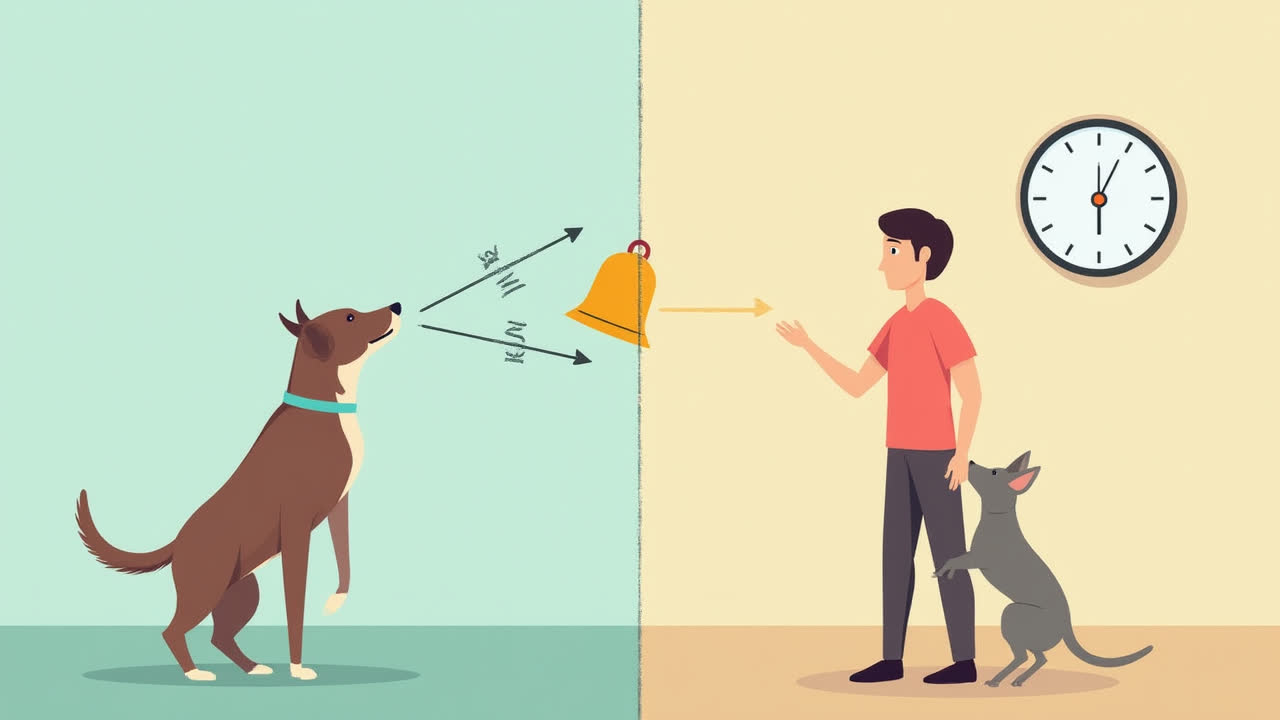
- Classical Conditioning: This involves learning to associate an unconditioned stimulus that already triggers a response with a new, neutral stimulus. The famous example is Pavlov's dogs, who learned to associate the sound of a bell (neutral stimulus) with food (unconditioned stimulus), eventually salivating at the bell sound alone.
- Operant Conditioning: This involves learning through rewards and punishments. Behaviors followed by positive consequences tend to be repeated, while those followed by negative consequences tend to be avoided. For example, when a child receives praise for getting good grades, they're more likely to study hard in the future.
These learning processes are deeply embedded in our educational systems, parenting approaches, and even marketing strategies. Understanding how associative learning works can help us recognize its influence in our daily lives and leverage it for more effective learning and behavior change.
What is Non-associative Learning?
Non-associative learning represents a simpler form of learning where there's no pairing between a stimulus and a behavior. Instead, it involves changes in how we respond to a single stimulus over time. I've always found this concept fascinating because it happens so automatically that we barely notice it in our daily lives.
In non-associative learning, an organism's behavior toward a certain stimulus changes over time without any evident association with consequences or other stimuli. This process is more primitive than associative learning and is observed across many species, from simple organisms to humans. It plays a crucial role in how we filter information from our environment and focus our attention on what's important.
What makes non-associative learning unique is that it doesn't involve making connections between different stimuli or behaviors. Instead, it's about how our response to a single, repeated stimulus changes over time. This type of learning helps us adapt to our environment by allowing us to either ignore irrelevant stimuli or become more sensitive to potentially important ones.
Types of Non-associative Learning
Non-associative learning can be divided into two primary mechanisms:
- Habituation: This is the decreased response to a frequently repeated stimulus. For example, when you first move to an apartment near a busy street, the traffic noise might keep you awake. However, after a few weeks, you barely notice it. Your nervous system has learned to tune out this constant, non-threatening stimulus.
- Sensitization: This is the enhanced response to a stimulus after repeated exposure. Unlike habituation, sensitization causes increased reactivity to a stimulus over time. For instance, if you've had a painful medical procedure, you might become increasingly anxious with each subsequent visit to the doctor, even if the later visits are for non-painful check-ups.
These non-associative learning processes help us navigate our complex environment by allowing us to filter out irrelevant information while remaining alert to potentially important stimuli. Without habituation, we'd be constantly overwhelmed by sensory input, and without sensitization, we might not be appropriately cautious in potentially dangerous situations.
Key Differences Between Associative and Non-associative Learning
Now that we've explored both learning types individually, let's examine the crucial differences between them. Understanding these distinctions helps us recognize how various learning processes influence our behavior and cognitive development.
| Comparison Point | Associative Learning | Non-associative Learning |
|---|---|---|
| Definition | Learning that occurs when two unrelated elements get connected through conditioning | Learning where behavior toward a certain stimulus changes over time without evident associations |
| Stimulus-Behavior Relationship | A stimulus is paired with a behavior | A stimulus is not paired with a behavior |
| Types | Classical conditioning and operant conditioning | Habituation and sensitization |
| Complexity | More complex form of learning | Simpler form of learning |
| Memory Involvement | Involves associative memory and connections | Minimal memory involvement |
| Examples | Food aversion after illness, studying for rewards | Tuning out background noise, increased sensitivity to allergens |
| Learning Process | Involves making connections between different stimuli or between stimuli and responses | Involves change in response to a single stimulus over time |
| Educational Application | Widely used in formal education and behavior modification | More relevant to attention regulation and sensory processing |
Applications in Education and Psychology
Both associative and non-associative learning have significant implications for education and psychology. Educators and psychologists leverage these learning principles to enhance teaching methods and therapeutic approaches.
Associative Learning Applications
In educational settings, associative learning principles are frequently applied to help students form connections between concepts and reinforce desired behaviors. Teachers use positive reinforcement (a form of operant conditioning) when they praise students for good work or offer rewards for achievement. This encourages students to continue performing well.
Classical conditioning principles are often utilized in therapy, particularly for treating phobias and anxiety disorders. Techniques like systematic desensitization gradually expose individuals to feared stimuli while they're in a relaxed state, helping them form new, non-fearful associations. I've seen remarkable transformations in people who once couldn't even look at a spider picture but eventually could calmly observe a real spider after such treatment.
Non-associative Learning Applications
Non-associative learning principles are particularly relevant to understanding attention and sensory processing. In educational environments, teachers might leverage habituation by changing their teaching methods or classroom arrangements periodically to prevent students from becoming desensitized to the learning environment.
In therapeutic contexts, habituation is often used to help individuals overcome anxiety disorders. Exposure therapy, for instance, relies on the principle that continued exposure to an anxiety-provoking stimulus (without negative consequences) will eventually reduce the anxiety response. Similarly, understanding sensitization helps explain why some individuals develop heightened sensitivity to certain stimuli and can guide interventions for conditions like post-traumatic stress disorder.
Real-World Examples and Everyday Applications
Looking at real-world examples helps us better understand how these learning processes shape our daily behaviors and experiences. Let's explore some common scenarios where associative and non-associative learning come into play.
Associative Learning in Everyday Life
- Marketing and Advertising: Companies frequently use associative learning principles to create positive associations with their products. For example, luxury brands pair their products with images of success, beauty, and exclusivity, hoping consumers will associate their products with these desirable qualities.
- Parenting: When parents consistently reward children for certain behaviors (like cleaning their room) and provide consequences for others (like not completing homework), they're applying operant conditioning principles.
- Safety Behaviors: If you've ever touched a hot stove and burned yourself, you likely learned to associate stoves with potential pain and became more cautious around them. This protective learning happens through associative processes.
Non-associative Learning in Everyday Life
- Environmental Adaptation: When you move to a new home, you might initially notice every little sound—the refrigerator humming, the heating system clicking on. After a while, these sounds fade into the background due to habituation.
- Alarm Fatigue: Healthcare workers in hospitals may gradually become habituated to frequently sounding alarms, potentially missing critical alerts—a phenomenon that illustrates both the adaptive and potentially problematic aspects of habituation.
- Sensory Sensitivities: For individuals with certain conditions like autism or sensory processing disorders, sensitization to stimuli like bright lights or loud sounds can be particularly pronounced, making everyday environments challenging to navigate.
Recognizing these learning processes in action can help us understand our own behaviors better and potentially make intentional changes to our learning environments. Whether you're trying to break a bad habit or create more effective learning experiences, understanding the underlying mechanisms can guide your approach.
Frequently Asked Questions About Associative and Non-associative Learning
How do associative and non-associative learning differ in terms of complexity?
Associative learning is generally considered more complex than non-associative learning because it involves forming connections between multiple stimuli or between stimuli and responses. It requires higher-level cognitive processing to recognize patterns and relationships between different elements. Non-associative learning, on the other hand, is a simpler form of learning that involves changing responses to a single stimulus over time, without forming connections to other stimuli or behaviors. This type of learning is more primitive and can be observed even in simple organisms that lack complex nervous systems.
Can both types of learning occur simultaneously in real-life situations?
Yes, associative and non-associative learning often occur simultaneously in real-life situations. For example, in a classroom setting, students might form associative connections between study behaviors and good grades (associative learning) while simultaneously becoming habituated to background noise or classroom routines (non-associative learning). Our brains are constantly processing multiple learning experiences at different levels. These learning processes can interact with and influence each other, creating complex patterns of behavior and response that help us navigate our environment effectively.
How do these learning types apply to different age groups?
Both associative and non-associative learning occur throughout the lifespan, but their manifestation and application may differ across age groups. Infants and young children demonstrate non-associative learning very early in development, showing habituation to familiar stimuli and sensitization to potentially important ones. As cognitive abilities develop, associative learning becomes more sophisticated, with school-age children showing increasingly complex ability to form associations. In older adults, while the fundamental mechanisms remain intact, the rate of forming new associations may slow, and previously habituated responses might require more reinforcement. Educational and therapeutic approaches should consider these age-related differences when applying learning principles.
Conclusion
The distinction between associative and non-associative learning represents a fundamental concept in understanding how humans and other organisms adapt to their environments and acquire new behaviors. While associative learning involves connecting previously unrelated elements through conditioning, non-associative learning reflects changes in response to a single stimulus over time without forming new connections.
Both learning types play crucial roles in our daily lives, from how we learn academic concepts to how we navigate social situations and respond to environmental stimuli. Educators, psychologists, and even marketers leverage these principles to influence behavior and facilitate learning.
By understanding the differences between these learning mechanisms, we can better recognize how our own learning processes work and potentially optimize our learning environments. Whether you're a student trying to master new material, a teacher designing effective lessons, or simply curious about how your brain adapts to the world around you, appreciating these learning processes can provide valuable insights into human cognition and behavior.
The next time you notice yourself automatically ignoring the ticking of a clock (habituation) or feeling a surge of happiness when you smell a certain perfume that reminds you of a loved one (associative learning), take a moment to appreciate the remarkable learning systems that help you navigate your world effectively. Isn't it fascinating how our brains continuously adapt and learn, often without our conscious awareness?


Related Posts